
Seclusion at Gorfanc
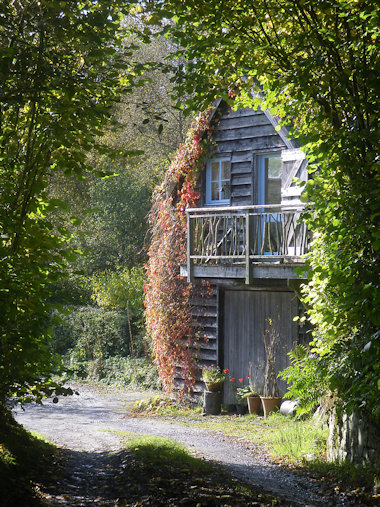
If you are seeking peace and quiet in the midst of the countryside, you will find it at the Hideaway at Gorfanc. On the edge of wild open uplands, Gorfanc is an 11-acre smallholding within a mile and a half of the village of Carno. Ideal for two and able to accommodate four, the Hideaway also offers perfect seclusion for writers and artists, and makes an ideal meditation retreat.
Life at the Hideaway
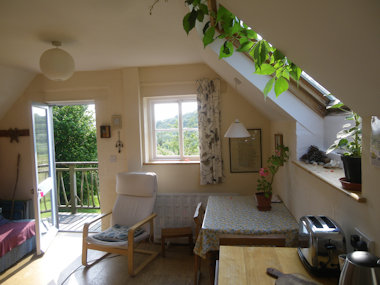
From the balcony entrance you will see only hills and woods and, in the distance, the craggy tops of Bwlchygarreg. You are free to walk almost anywhere, and might walk for miles without crossing a road or meeting anyone. In the evenings you might stroll down to the pub, or snuggle down by the woodburner — and just step outside on a starry night to be amazed by the clarity of the skies. You can buy honey from the Gorfanc bees, free-range eggs, home-made jam and made-to-order organic wholemeal bread, and there may be organically grown produce from the garden. Dogs — with their own beds and towels for muddy feet — are welcome (see our dog-friendly guide), and therapeutic massage is available. Simple, clean and bright, yet cosy and comfortable, the Hideaway is a place you will quickly feel at home.
Camping close to nature
The wonderful wildlife habitat at Gorfanc also provides a close-to-nature camping environment — campfires are almost compulsory! There are several places suitable for pitching a tent: tucked away beside a stream, or in a more open spot with a wider view.
The Montgomeryshire uplands
Carno sits in the hill country of old Montgomeryshire, between the Dyfi Valley and Newtown. This is the landscape Glyndŵr's Way was made for — the 135-mile National Trail winds through these uplands between Knighton and Welshpool via Machynlleth, topping out at Foel Fadian (510 m), and you can walk here for hours meeting more sheep than people. To the west, Machynlleth offers the Wednesday market (chartered 1291), the MOMA galleries and the Owain Glyndŵr Parliament House; southwards lies Llyn Clywedog reservoir, whose 72 m dam is the tallest concrete dam in the UK, and the magnificent 20-mile mountain road between Llanidloes and Machynlleth via Dylife — one of the great scenic drives in Wales, passing the viewpoint where broadcaster Wynford Vaughan-Thomas judged the panorama towards Snowdon the finest in the country. Those clear starry skies the owners promise are no accident: there is very little out here to make light.
Practical Information
The Hideaway sleeps two comfortably and up to four; dogs are welcome, produce from the smallholding is on sale, and camping pitches are available. Details were supplied by the business — please contact the owners to confirm current prices, availability and camping arrangements.
Pippa Scott and Rob Ritchie, The Hideaway, Gorfanc, Carno, Caersws, Powys SY17 5JP
Telephone (UK): 01686 420423 · Telephone (International): +44 1686 420423
Email: [email protected]
Website: www.the-gorfanc-hideaway.co.uk
Getting to Carno, with or without a car
Carno village, with its shop and pub, is about a 25-minute walk; the bus stop is less than a mile and a half away, and the buses through Carno run two-hourly between Newtown and Machynlleth. The nearest station is Caersws, six or seven miles off on the Cambrian Line, with trains roughly two-hourly via Shrewsbury and Birmingham one way and Machynlleth the other (see getting here). Come by public transport and the owners will usually meet your bus or train.
The trail, the reservoir and the Biosphere
Glyndŵr's Way tops out at Foel Fadian, 510 m, south-east of Machynlleth, with a long view down the Dulas valley to the town and the sea. South, Llyn Clywedog is a 615-acre reservoir off the B4518 near Llanidloes, renowned for fly fishing, with red kites over the water; the ruins of the Bryn-tail lead works below the dam are in Cadw's care and free to walk into. Carno itself came inside Wales's UNESCO Dyfi Biosphere when the area was extended in 2021.
Booking direct, and what the tariff covers
The owners use no booking agent, so there are no booking fees, and a £50 deposit per week or part-week secures a stay. The tariff is for the whole place, not per person, and split into two seasons — roughly £150 for two nights between October and March, rising to about £400 for a week between April and September — with a reduction for single occupancy and extras for a third or fourth person, dogs, electricity and logs. Camping is charged per person per night, showers and firewood extra. They also run coracle-making weekends, with 2026 dates in late March, April and early May. Confirm all of it with them direct.
 Day trips